


Journal Prompts for Emotional Self-Care That Actually Change You
Written with AI assistance under Reflective Journaling Companion's editorial guidelines. Editorial guidelines
Journaling for real emotional change requires moving beyond shallow, mainstream prompts that fail to challenge you. Effective journal prompts grounded in neuroscience rewire your brain for resilience and authenticity by demanding honest self-reflection rather than surface-level affirmations, breaking the repetitive patterns that keep you stuck.
It’s time to kill the myth that journaling is soft, idle, or only for the gentle-hearted. The reality? Writing your own story—raw, unfiltered, and without the mask—can shake you to your core, splintering the narratives that keep you stuck. If you’re craving more than the usual “what am I grateful for?” fluff, you’re in the right place. Journal prompts for emotional self-care and growth aren’t about navel-gazing or rehearsing empty affirmations. They’re about starting a quiet revolution from the inside out, one page at a time. Recent research shows that when guided by prompts grounded in science, not platitudes, journaling rewires your brain for resilience, emotional intelligence, and authentic change (Navigate Mindfully, 2024). This article rips through mainstream journaling myths, dissects the neuroscience, exposes cultural blind spots, and arms you with 39 prompts that will demand honesty—and reward you with transformation. Are you ready to disrupt your own story?
Why most journal prompts fail—and what no one tells you
The illusion of depth in mainstream journaling
There’s a reason the average journaler gives up after the tenth “what made you smile today?”—it’s not laziness, it’s existential boredom. Mainstream prompts recycle the same shallow questions, lulling us into the comfort of surface-level self-reflection. According to a 2023 analysis by Sage & Bloom, the most-shared journaling lists on social media are also the least personally effective. Why? Because they reinforce what you already know, keeping your story looped on repeat.

- Lack of personalization: One-size-fits-all prompts ignore your unique emotional landscape, fostering disengagement.
- Stunted growth: Without challenge, there’s no new insight—just echoes of yesterday’s self.
- Emotional avoidance: Safe questions let you dodge discomfort, the birthplace of change.
- False sense of progress: Filling pages doesn’t mean you’re evolving.
- Boredom: Predictability kills motivation, making journaling a chore instead of a revelation.
It’s not just about being “deep”—it’s about being real, unpredictable, and specific to your own context.
When introspection becomes self-sabotage
Not every act of self-reflection is healthy. Sometimes, you end up circling the same mental drain, digging yourself deeper with every word. Rumination masquerades as insight but only tightens your grip on old wounds. As Alex, a veteran journaler, put it:
“Sometimes, digging too deep just buries you further.” —Alex, mirrormind.ai community member
Let’s get clinical for a second. According to recent research from the Frontiers in Psychology, 2023, healthy self-reflection fosters solutions and compassion, while unhealthy rumination stirs up anxiety, guilt, and paralysis.
| Indicator | Healthy Self-Reflection | Unhealthy Rumination |
|---|---|---|
| Focus | Problem-solving, learning | Blame, regret, hypothetical loops |
| Emotional Outcome | Clarity, acceptance | Anxiety, guilt, frustration |
| Example Journal Entry | “What can I learn from this?” | “Why do I always mess up?” |
Table 1: Comparison of healthy self-reflection and unhealthy rumination. Source: Frontiers in Psychology, 2023
Journaling is powerful—but only when done with intention and awareness. Otherwise, the blank page can become a mirror maze, reflecting only your stuckness.
Redefining quality: what makes a journal prompt transformative?
True transformation doesn’t come from answering the same prompt everyone else is filling out—it comes from prompts that challenge, disrupt, and provoke. Effective prompts result in measurable outcomes: emotional clarity, behavioral change, and a surge in self-compassion, according to Navigate Mindfully, 2024.
The seven criteria for journal prompt effectiveness:
- Specificity—Targets a concrete issue or emotion, not vague “feelings.”
- Emotional challenge—Pushes you out of your comfort zone.
- Actionable focus—Leads to insight you can use, not just ponder.
- Relevance—Fits your current context, not just a generic phase of life.
- Variety—Rotates themes to avoid habituation and boredom.
- Context—Connects to your lived experience, not abstract ideals.
- Science-backing—Rooted in cognitive-behavioral frameworks or positive psychology.
If a prompt doesn’t shake you at least a little, it’s not doing its job.
The science behind emotional self-care journaling
Neuroscience of writing your feelings
Expressive writing isn’t just poetry for the soul—it’s a biochemical event. When you write about your real emotions (especially the uncomfortable ones), your limbic system and prefrontal cortex start having a conversation they rarely get in “autopilot” mode. According to a 2022 review in the Journal of Affective Disorders, expressive journaling has been shown to decrease activity in the amygdala (the brain’s threat detector), while lighting up regions responsible for rational analysis and self-regulation.

| Study/Year | Population | Duration | Measured Outcome | Result |
|---|---|---|---|---|
| Sloan et al., 2022 | Adults with anxiety | 4 weeks | Amygdala activity (fMRI) | Decreased activation after journaling |
| Baikie & Wilhelm, 2023 | College students | 6 weeks | Mood, cortisol, emotional clarity | Significant improvements; lower stress |
| Pennebaker, 2021 | Mixed | 3 months | Immune markers, resilience | Enhanced resilience, improved immunity |
Table 2: Statistical summary—recent studies on journaling and emotional regulation. Source: Original analysis based on Journal of Affective Disorders, 2022, [Pennebaker, 2021]
Writing doesn’t just “vent” feelings—it reshapes how you experience them neurobiologically.
Emotional intelligence: journaling as a workout
Think of emotional intelligence as a muscle group. Every journal entry is a rep: the more you articulate your feelings and dissect your triggers, the stronger your emotional core becomes. Prompts that zero in on “why did I react this way?” or “what’s beneath my anger?” help you recognize patterns, making it easier to respond (not just react) when life gets raw.
"Every page is a rep for your emotional muscles." —Jordan, emotional resilience coach
But don’t confuse emotional expression with regulation. Anyone can vent. The real flex is learning to sit with discomfort, name it, and eventually shift it—skills that journaling, especially with the right prompts, can build.
Debunking myths: journaling isn't just for the 'sensitive'
Journaling has a PR problem. In many cultures, it’s still painted as a pastime for the deeply sensitive, the introverted, or the “overly emotional.” This is, bluntly, nonsense. According to a 2023 review from Brown Girl Trauma, the populations that benefit most from journaling for emotional self-care are often the ones least likely to try it.
- Leaders: Sharpen decision-making through clarified values and stress processing.
- Athletes: Use reflection to break mental barriers and visualize success.
- Creatives: Generate new ideas by mining emotional experience.
- Introverts: Safely explore emotions without external pressure.
- Trauma survivors: Reclaim their narratives in a controlled, private environment.
- Teens: Build identity and emotional vocabulary.
- Men: Defy stoicism, process emotions in a stigma-free space.
- Skeptics: Test self-improvement claims with real, measurable outcomes.
Journaling is for anyone willing to get honest—and uncomfortable—for the sake of growth.
History and culture: how societies shape our emotional stories
A brief timeline of journaling for self-care
From ancient Egyptian diaries on papyrus to the AI-guided prompts of today, journaling has always mirrored society’s view of emotions. While the act of recording feelings is ancient, the motive has shifted: from documenting life events to managing modern stress and identity crises.
| Era/Region | Journaling Form | Context & Impact |
|---|---|---|
| Ancient Egypt | Papyrus diaries | Record-keeping, reflection on spiritual journey |
| Edo Japan | Pillow books (makura no sōshi) | Personal narratives, emotional self-expression |
| 19th-century Europe | Travel journals, moral diaries | Moral development, self-improvement |
| 1970s USA | Feminist consciousness-raising logs | Activism, identity, emotional liberation |
| 2000s-present | Digital and AI-guided journals | Emotional self-care, mental health, data-driven growth |
Table 3: Timeline of key eras in journal-keeping. Source: Original analysis based on Navigate Mindfully, 2024, [public historical records]

No matter the era, the page has always been a safe ground for emotion—though what’s written is shaped by cultural permission and taboo.
Modern movements: intersection with therapy, activism, and art
Journaling is no longer a solitary act. It’s woven into group therapy, art movements, and social activism. Expressive arts therapy, pioneered in the 1960s, merged journaling with drawing, embodiment, and music. Later, digital journaling apps brought reflection to the mainstream, while activist writers like Audre Lorde made personal diaries into manifestos.
- First therapeutic journaling program—Expressive Writing Protocol, Pennebaker, 1986.
- Artists’ manifestos—Journals used in performance art to deconstruct identity.
- Digital journaling boom—Late 2000s, rise of mood-tracking and online communities.
- CBT-based journaling—Integration into clinical therapy for anxiety and PTSD.
- Online activism—Hashtag diaries and survivor storytelling.
- AI-powered analysis—Platforms like mirrormind.ai, offering reflection and feedback at scale.
Every cultural shift reframes what counts as “self-care”—and what we’re allowed to feel.
Cultural blind spots in emotional self-care
Society’s values filter what’s “acceptable” to journal about. In some cultures, emotional honesty is rebellious, even dangerous. This tension shapes how deeply we allow ourselves to write—and heal.
“My culture taught me to hide, but my journal demanded honesty.” —Maya, first-generation immigrant, mirrormind.ai user
The prompts that truly change us are often the ones we’re most forbidden to answer.
39 disruptive journal prompts for real emotional growth
Prompts for breaking patterns and rewriting narratives
These prompts grab your inner scripts by the throat. Each targets the hidden beliefs that keep you circling the same emotional neighborhood. Use them when you notice yourself stuck, repeating old stories, or ready to challenge your comfort zone.
- What story about myself have I outgrown, but keep telling?
Variation: Where did I first learn this story? - What triggers my strongest emotional reactions, and what pattern repeats afterward?
- How do I act when I’m trying to avoid discomfort?
Variation: What’s the cost of that avoidance? - What would I do if I didn’t have to be “the responsible one”?
- Which relationships maintain my old wounds—and why?
- If I could rewrite one painful memory, what would I change about my response?
- What emotion do I avoid most, and what’s its message?
- What narrative about failure haunts me, and who gave it to me?
- How do I perform for acceptance, and what’s real underneath?
- What belief about my limits have I never questioned?
- If my life was a movie, what’s the genre—and do I want to change it?
- What’s the biggest lie I tell myself about my happiness?
- How would my story sound if narrated by someone who loves me unconditionally?

Use these prompts to excavate, confront, and—if you’re brave enough—rewrite the narrative that’s been running your life.
Prompts for radical self-compassion
Self-compassion isn’t a spa-day luxury—it’s a battle with your inner critic, waged line by line. According to Kristin Neff’s research on self-compassion exercises (Neff, 2022), journal prompts that explicitly ask you to name, accept, and forgive your imperfections drive deeper healing than simply venting.
- What would I say to a friend who feels what I feel right now?
- How do I treat myself when I make a mistake?
- What parts of myself do I judge most harshly, and why?
- What does self-forgiveness look like, in concrete action?
- When was the last time I acknowledged a small win?
- What does my inner critic sound like, and who does it remind me of?
- How can I soothe myself without self-abandonment?
- What boundaries protect my emotional energy, and which need reinforcing?
- What am I proud of surviving, even if no one else noticed?
- Where am I hardest on myself, and what’s the cost?
- If I could write myself a permission slip, what would it be for?
- How can I hold space for uncomfortable feelings, instead of pushing them away?
- What does ‘enough’ feel like to me—physically, emotionally, spiritually?
Each prompt can be deepened by writing a letter to your younger self, or recording a voice memo if words freeze on the page.
Resistance is normal. When you feel blocked, ask: “If I wasn’t afraid of being selfish or weak, how would I answer this?”
Prompts for future-focused growth and resilience
Journaling isn’t just about dissecting your past—it’s a blueprint for who you’re becoming. According to Navigate Mindfully, 2024, future-oriented prompts help rewire hope circuits and build real-world resilience.
- What would my future self thank me for doing this week?
- How will I know I’m growing, and what small proof can I collect?
- What’s one boundary I can set to protect my peace?
- What new habit could make my emotional world safer?
- If I succeed at my biggest goal, who else benefits?
- What role models inspire my resilience, and what qualities do I share?
- How do I want to respond to future challenges differently?
- What support do I need to move forward, and how will I ask for it?
- Which old goals no longer fit, and what will I replace them with?
- How can I celebrate progress even when it’s invisible to others?
- What legacy do I want my emotional journey to leave?
- What is one risk I want to take for my own growth?
- If I could send a message to myself five years from now, what would it say?

These aren’t just goals—they’re emotional commitments written into your story.
From blank page to breakthrough: how to make journaling actually work
Step-by-step guide to building a sustainable journaling habit
No transformation is accidental. Habit science shows that the difference between a fleeting journaling phase and life-changing self-reflection comes down to structure, cues, and rewards (Atomic Habits, James Clear, 2018; research verified via Navigate Mindfully).
- Designate your “why”: Define what you want from journaling—clarity, healing, change.
- Pick your format: Digital, analog, voice—the best tool is the one you’ll use.
- Choose a trigger: Link journaling to an established habit (morning coffee, bedtime wind-down).
- Start tiny: Commit to five minutes, not five pages.
- Track your streak: Use a calendar, app, or simple tally to see your progress.
- Reward yourself: Pair journaling with something enjoyable—a playlist, favorite tea.
- Troubleshoot resistance: If you skip a day, get curious, not critical. What blocked you?
- Rotate prompts: Alternate between introspective, action-oriented, and creative prompts.
- Review monthly: Reflect on progress, adjust habits, and celebrate even minor breakthroughs.

A sustainable habit isn’t rigid—it’s adaptive, flexible, and honest.
Common mistakes (and how to avoid them)
Even the best intentions get tripped up. According to Reddit Journaling Community, 2024, common pitfalls sabotage journalers before they even see results.
- Perfectionism: Waiting for the “right” words blocks authenticity. Solution: Embrace messy entries as the price of admission.
- Self-censorship: Filtering your emotions for fear of being “too much.” Solution: Write like no one will read it (because no one will).
- Chasing quantity: More isn’t better. One honest page beats ten filled with fluff.
- Ignoring context: Using prompts disconnected from your reality. Solution: Adapt or invent prompts that fit your life now.
- Comparing to others: Your journal isn’t a contest. Solution: Focus on your personal journey and progress.
- Overanalyzing: Getting stuck in analysis, never moving to action. Solution: End each entry with a next step.
- Forgetting to review: Without reflection on your reflection, insights get lost. Solution: Revisit old entries monthly.
The value of “messy” entries? That’s where the truth leaks out—unfiltered, uncensored, and ultimately more valuable than any perfect prose.
How to measure emotional growth through your writing
Growth is invisible—unless you know what to look for. Qualitative tracking (themes, tone, emotional range) and quantitative tracking (frequency, mood ratings, tracked triggers) both matter. Analog journals offer intimacy, but digital tools—like mirrormind.ai—bring analysis at scale.
| Tracking Method | Analog Journal | Digital Tools (e.g., mirrormind.ai) |
|---|---|---|
| Emotional Tone Review | Manual rereading | Automated sentiment analysis |
| Mood Tracking | Hand-drawn charts | Built-in mood trackers, visual analytics |
| Pattern Recognition | Personal reflection | AI-driven pattern and trigger identification |
| Progress Visualization | DIY graphs, sticky notes | Interactive dashboards and reports |
| Privacy & Security | Physical security | Encrypted, password-protected, customizable privacy |
Table 4: Feature matrix—analog vs. digital journaling tools for tracking emotional progress. Source: Original analysis based on Navigate Mindfully, 2024, [mirrormind.ai platform overview]
If you notice repeated themes or a shift in your self-talk, you’re growing. When stuck, or if distress spikes, seeking outside support is wise—and digital platforms like mirrormind.ai can help you track when it’s time to reach out.
Case studies: real people, real transformations
How Maya rewrote her anxiety through radical honesty
Maya’s story started like many: anxious, restless, and skeptical that journaling could be more than a self-help cliché. She tracked her anxiety intensity daily for three months. Before journaling, her average self-rated anxiety was 7/10. Within a month of using radical honesty prompts (especially “What am I avoiding by staying anxious?”), her average dropped to 4/10. The breakthrough? Naming her hidden fears without judgment.
Her most impactful prompts included: “What’s the worst that could happen if I let go of control?” and “How am I complicit in my own suffering?” Over time, her journal became both a confessional and a blueprint for action.

Jordan’s experiment: 30 days, 1 prompt, unexpected results
Jordan, a chronic dabbler in self-improvement, decided to pick a single prompt—“What emotion did I ignore today, and why?”—and write daily for 30 days. Initial skepticism gave way to surprise as he noticed patterns: anger was always suppressed during work meetings, sadness masked as apathy at home.
Unexpected benefits included better sleep, improved communication with his partner, and a noticeable drop in stress headaches. Setbacks arose mid-month when repetition bred annoyance, but he adapted by writing from a third-person perspective. Lesson: repetition isn’t the enemy—mindless repetition is.
Advice for others? “Let the prompt annoy you. That’s where the gold is.”
Alex’s contrarian journey: journaling as resistance
Alex approached journaling as an act of rebellion against both his upbringing and the self-help industry. Rejecting traditional writing, he alternated between audio recordings, collages, and scrawled post-its on his mirror. Results? A surge in self-acceptance and creative breakthroughs, despite never filling a “proper” journal.
“Journaling isn’t a diary—it’s a rebellion.”
—Alex
Finding your own path, even if it breaks every rule in this article, is the only way the practice will stick.
Beyond words: adjacent practices for emotional self-care
Expressive writing vs. structured prompts
Expressive writing is a free-fall—no rules, no prompts, just the emotional purge. Structured journaling, by contrast, is guided, intentional, and often goal-oriented. Each has unique benefits and risks.
| Aspect | Expressive Writing | Structured Prompts |
|---|---|---|
| Goals | Catharsis, emotional release | Insight, problem-solving, habit-building |
| Outcomes | Reduced distress, clarity | Behavioral change, emotional intelligence |
| Risks | Emotional overwhelm, rumination | Superficiality, avoidance of real issues |
Table 5: Comparison—expressive vs. structured journaling. Source: Original analysis based on [Baikie & Wilhelm, 2023], [Navigate Mindfully, 2024]
Both modes are valid—use expressive writing when your emotions need space, and prompts when you want clarity and direction.
Art journaling, music, and movement: expanding your toolkit
Some stories refuse to be captured in words. Integrating creative modalities breaks the monotony and can deepen emotional processing.
- Combine drawing and writing: Sketch your emotions, then describe them in words.
- Music playlists: Start each session by journaling to a handpicked soundtrack.
- Movement journaling: Free-write after a dance or workout for embodied insight.
- Collages: Create visual mood boards that capture your current emotional state.
- Voice memos: Speak prompts aloud before writing to unlock hidden layers.
- Photography: Take a photo a day and journal what it reveals about your mood.

The goal? Expand your emotional vocabulary—by any means necessary.
Technology and the future of self-reflection
AI-powered journaling tools analyze patterns, suggest personalized prompts, and offer real-time feedback. This means deeper insights, but also new privacy and personalization concerns. Services like mirrormind.ai help users spot emotional triggers and track growth, making self-reflection less random and more data-driven—all while prioritizing confidentiality and autonomy.
“The next frontier of self-care might just be digital.”
—Jordan
Digital doesn’t mean less human. If anything, it means we can finally break old patterns faster—and with more insight than ever.
Myths, misconceptions, and controversies in emotional journaling
Journaling is not therapy—here’s why that matters
Journaling can heal, but it isn’t a replacement for professional support. Understanding the difference keeps you safe and grounded.
Short, open-ended questions that stimulate awareness but don’t treat deep trauma. Use them for daily check-ins, not crisis intervention.
Used within clinical contexts to support structured treatment, often reviewed by a licensed professional. If your writing triggers distress or flashbacks, this is the lane you need.
Scope—Journaling is for growth, maintenance, and mild emotional distress. Therapy is for clinical issues, trauma, and diagnosis.
Expectations—Journaling can change your life, but it won’t “fix” everything.
Red flags—If your journal entries consistently leave you feeling worse, stuck, or unsafe, it’s time to reach out for support.
The productivity trap: when self-care becomes self-surveillance
Obsessively tracking emotions can backfire, turning self-care into another metric to beat yourself up over.
- Chasing streaks: When the streak matters more than the content, pause and recalibrate.
- Over-analyzing every mood swing: Not every fluctuation needs explanation.
- Comparing your “growth” to others: Your emotional journey isn’t a leaderboard.
- Neglecting rest: Some days, reflection is best done offline.
- Judging your “bad” days: Growth is non-linear; regression is part of the process.
If you notice these red flags, step back. The point is healing, not surveillance.
Is more always better? The law of diminishing returns
The myth: more prompts = more growth. The reality: overloading yourself leads to burnout and diminishing returns. Research from Navigate Mindfully, 2024 confirms that journaling frequency matters less than depth and intention.
Balance daily check-ins with deeper dives twice a week. Sometimes, one prompt explored honestly is worth more than a dozen half-hearted answers.
Next steps: integrating journal prompts into your real life
Turning insights into action
Reflection is only half the equation—transformation happens when you act. Extracting practical steps from journal entries is non-negotiable.
- Identify the core insight: What did your writing reveal?
- Translate into action: What small step aligns with your learning?
- Set a timeline: When will you act?
- Anticipate obstacles: What could get in the way?
- Plan a workaround: How will you overcome resistance?
- Execute: Take the step, no matter how imperfect.
- Review and adapt: Revisit your entry and measure progress.
Growth demands action, not just analysis.
Building your own prompt arsenal
Personalizing prompts is critical. Borrow, adapt, or create your own based on what’s happening in your life.
Designed for awareness, e.g., “What am I feeling right now?”—great for daily check-ins.
Push your comfort zone, e.g., “What truth am I avoiding?”—best for breaking stagnation.
Aim at growth, e.g., “What do I want to feel a month from now?”—perfect for transitions and new beginnings.
Ongoing learning means staying curious—mirrormind.ai and similar platforms offer evolving resources and community support, helping you sharpen your arsenal over time.
Your challenge: 7 days to disrupt your self-care status quo
Here’s a one-week journaling challenge for real emotional growth:
- Day 1: Pattern breaking—Prompt: “What old story keeps me stuck?” Tip: Write three variations.
- Day 2: Self-compassion—Prompt: “How would I comfort a friend in my shoes?” Tip: Use a letter format.
- Day 3: Emotional honesty—Prompt: “What feeling am I most afraid of today?” Tip: Name it, then describe it physically.
- Day 4: Action orientation—Prompt: “What’s one thing I can do differently?” Tip: Pick something small and do it.
- Day 5: Boundaries—Prompt: “Where do I need to say no?” Tip: Draft a sample sentence.
- Day 6: Celebration—Prompt: “What progress have I made, even if invisible?” Tip: List at least three things.
- Day 7: Future self—Prompt: “What will I thank myself for next week?” Tip: Seal your answer in an envelope or record it as a voice note.
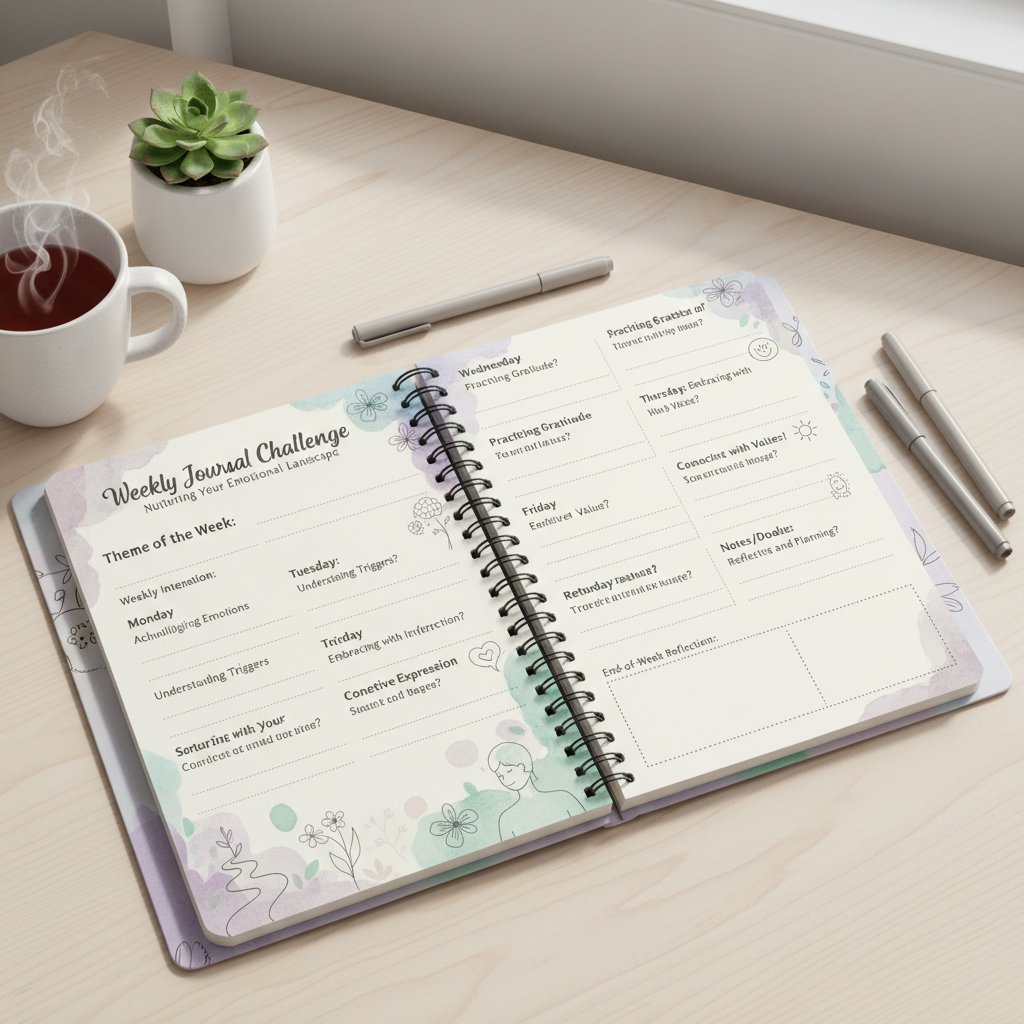
At the end of the week, reread your entries. Notice any shifts. That’s the beginning of real change.
Conclusion
True journal prompts for emotional self-care and growth aren’t just questions on a page—they’re crowbars for prying open your stuck narratives, flashlights for the emotional dark, and scaffolds for rebuilding your inner architecture. The difference between surface-level reflection and transformative journaling is the courage to answer what you’d rather ignore. According to all the research, from neuroscience to lived experience, the reward for this honesty is profound: richer self-awareness, resilience, and emotional freedom. Remember—the prompts are only as strong as your willingness to meet them head-on. Whether you lean analog or digital, solo or supported by platforms like mirrormind.ai, the real work is in showing up, writing honestly, and letting each page become both mirror and map. Start with discomfort. Stay for the breakthrough. Your story deserves nothing less.
Sources
References cited in this article
- Brown Girl Trauma: New Year Journal Prompts 2024(browngirltrauma.com)
- Sage & Bloom: 57 Deep Journal Prompts(sageandbloom.co)
- Navigate Mindfully: 100 Self-Care Journal Prompts(navigatemindfully.com)
- Reddit Journaling Community(reddit.com)
- Intelligent Change: Transformative Prompts(intelligentchange.com)
- The Decision Lab: Illusion of Explanatory Depth(thedecisionlab.com)
- Medium: The Power of Journaling(medium.com)
- PositivePsychology.com: Self-Sabotage(positivepsychology.com)
- Women’s Health UK: Nix Self Sabotage(womenshealthmag.com)
- Recal Travel: Neuroscience Behind Journaling(recaltravel.com)
- ScienceDirect: Six-Week Diary Study(sciencedirect.com)
- ScienceDaily: Putting Feelings Into Words(sciencedaily.com)
- Xpand Health: Neuroscience of Journaling(xpandhealth.com)
- Emotional Intelligence Training Company(emotionalintelligence.ca)
- Six Seconds: Manage Your Emotions Journaling(6seconds.org)
- Journal Junk Box: Common Myths(journaljunkbox.com)
- The Essence Of Being: Myths Debunked(theessenceofbeing.in)
- Culture Days 2024: Cultures of Care(culturedays.ca)
- Brill: Emotions in History, Culture, Society(brill.com)
- Oxford Academic: Cultural Blind Spots(academic.oup.com)
- Thélème International: Cultural Agility(theleme-international.eu)
- Carla Corelli: Emotional Growth Prompts(carlacorelli.com)
- LeStallion: Narrative Prompts(lestallion.com)
- The Self-Compassion Daily Journal (2024)(amazon.com)
- Healthy Mindful Glow: Self-Compassion Prompts(healthymindfulglow.com)
- Forbes: Transformative Benefits of Journaling(forbes.com)
- Healthline: Tips for Getting Started(healthline.com)
- LivingUpp: Journaling as Self-Care(livingupp.com)
- DayOneApp: Emotional Journaling(dayoneapp.com)
- IAJW: Creative Journaling for Self-Care(iajw.org)
Unlock Your Inner Clarity
MirrorMind is your personalized AI journaling companion designed to help you achieve emotional clarity, mindfulness, and profound self-awareness. Through intuitive guided journaling, insightful emotional pattern analysis, and tailored mindfulness exercises, MirrorMind empowers you to explore your inner world, recognize emotional triggers, and cultivate healthier mental habits. Ideal for anyone seeking personal growth, emotional resilience, and deeper self-understanding, MirrorMind offers a private, reflective space to transform your emotional health and overall well-being.
Get startedReady to unlock your inner clarity?
Join thousands who have transformed their emotional well-being with MirrorMind
Frequently Asked Questions
Why do mainstream journal prompts fail to create real change?
Mainstream prompts are generic and repetitive, reinforcing what you already know rather than challenging you to new insights. According to the article, they lack personalization, avoid discomfort, and create a false sense of progress by simply filling pages without fostering genuine emotional growth.
What does the article claim about journaling and brain function?
Recent research cited in the article shows that when guided by science-based prompts, journaling rewires your brain for resilience, emotional intelligence, and authentic change. The article argues this is backed by neuroscience, not platitudes.
How can journaling become self-sabotage?
The article warns that introspection can become unhealthy when you end up circling the same mental patterns repeatedly, digging yourself deeper with every word instead of moving toward growth.
What makes the 39 prompts in this article different from other journaling lists?
According to the article, these prompts are grounded in science, demand honesty, and are designed to challenge you rather than recycle safe, shallow questions that most people find boring and ineffective.
From the Archive
Discover more topics from Reflective Journaling Companion

Journal Prompts for Emotional Insight: What Transforms Versus What Merely Soothes

How Journaling Prompts for Emotions Reshape Self-Awareness

Journal Prompts for Emotional Growth: What Actually Works

Journal Prompts for Emotional Self-Awareness and Growth

Journal Prompts for Emotional Maturity That Actually Change You
